GPU Guide
NCShare comprises of 4 GPU nodes with 192 CPU cores (Intel Xeon Platinum 8568Y+) and 8 NVIDIA H200 GPUs w/141GB of VRAM, 2TB RAM each (32 GPUs in total). This page guides users on how to access and utilize the H200 GPUs using slurm and Open OnDemand.
There are three GPU partitions available on NCShare,
| Partition | Description |
|---|---|
| gpu | General access to H200 GPU nodes. Jobs are pre-empted (cancel and requeue) for higher priority jobs. |
| interactive-gpu | Short term GPU jobs with a max walltime of 1 hour. Higher priority than gpu. |
| gpu-hp | High priority access to H200 GPU nodes. Restricted to NSF GaaS partner institutions. Each institution is allocated a monthly pool of GPU-hours. |
gpu partition
- General access, scavenger-like partition
- Simultaneous GPU limit per user (MaxTRESPU) = 8
- Max Walltime = 2 days
- Pre-emption = cancel and requeue
- QoS = normal (default)
- Unlimited usage quota
Warning
Jobs on the gpu partition may be pre-empted (cancelled and requeued) to accommodate higher-priority jobs on the interactive-gpu or gpu-hp partition. Please ensure your workflows are checkpointed to avoid loss of progress.
interactive-gpu partition
- General access partition for short-term GPU jobs
- Simultaneous GPU limit per user (MaxTRESPU) = 8
- Simultaneous job limit per user (MaxSubmitJobsPU, MaxJobsPU) = 1
- Max Walltime = 1 hour
- Pre-emption = No
- QoS = N/A (the partition itself assigns jobs a partition-specific QoS)
- Unlimited usage quota
gpu-hp partition
- High-priority partition for NSF GaaS partner institutions
- Simultaneous GPU limit per user (MaxTRESPU) = 8
- Max Walltime = 7 days
- Pre-emption = No
- Monthly GPU usage quota per institution
The institutional quota is reset on the first day of each month at 00:00 ET.
The institiution-specific QoS values are provided in the table below. Replace <institution-qos> with the QoS value corresponding to your institutional account.
| Account | QoS |
|---|---|
| duke | duke_h200_hp |
| unc | unc_h200_hp |
| ncsu | ncsu_h200_hp |
| ncat | ncat_h200_hp |
| uncc | charlotte_h200_hp |
| wssu | wssu_h200_hp |
| nccu | nccu_h200_hp |
| davidson | davidson_h200_hp |
| uncfsu | fsu_h200_hp |
E.g., if you are a user from Duke University, you would use the following flags to request 4 H200 GPU on the gpu-hp partition,
To check your monthly GPU usage quota, run the following command from a NCShare login node,
This will show you the monthly quota for your institution, the amount of GPU-minutes used, and the remaining GPU-minutes.
E.g.,
$ get_gpu_quota_account.sh
Institutional Usage (GPU-minutes)
QoS | Quota | Used | Remaining
---------------------+----------------------+----------------------+---------------------
duke_h200_hp | 216000 | 10964 | 205036
The -H will show the usage in GPU-hours instead of GPU-minutes.
$ get_gpu_quota_account.sh -H
Institutional Usage (GPU-hours)
QoS | Quota | Used | Remaining
---------------------+----------------------+----------------------+---------------------
duke_h200_hp | 3600.00 | 182.00 | 3417.00
Requesting Access
To access the GPU resources, interested users should contact their institutional representative, once they have an NCShare account. This should grant them access to the gpu, and interactive-gpu partition. Access to the high-priority gpu-hp allocation for NSF GaaS partnering institutions is managed through an institutional representative as well and is granted on a case-by-case basis at the descretion of the institutional representative. A general guideline for granting access to the gpu-hp partition is given below.
- Prioritization will be given to users involved in multi-institutional research collaborations across North Carolina
- Users whose institutional GPU resources are insufficient for their research needs will be prioritized over users with sufficient institutional GPU resources
- Users should demonstrate at least a week's worth of GPU utilization on the NCShare
gpupartition orinteractive-gpupartition (or an equivalent H200 partition) with 70%> GPU efficiency and 50%> GPU-memory efficiency (see Measuring Efficiency) - Users not demonstrating efficient GPU usage on
gpu-hpwill be removed from the partition
To request access to the gpu-hp partition, users should reach out to their institutional representative with the following information,
- Explain why your institutional GPU resources are insufficient for your research needs
- Provide a description of your proposed project and the duration of access to the
gpu-hppartition - Provide evidence of efficient GPU usage on the
gpuorinteractive-gpupartition (or an equivalent H200 partition) - If you have an emergency need for GPU resources (e.g., a grant deadline), please explain the nature of the emergency and the resources needed to address it
Once access is granted, users can request GPU nodes through Open OnDemand or through slurm batch job scripts. Please see the sections below for more information on how to request and use GPU resources.
Using H200 GPUs on Open OnDemand
NCShare users can access H200 GPUs through Open OnDemand containers such as Jupyter Lab. A few of these Apptainer containers have been built with GPU support.
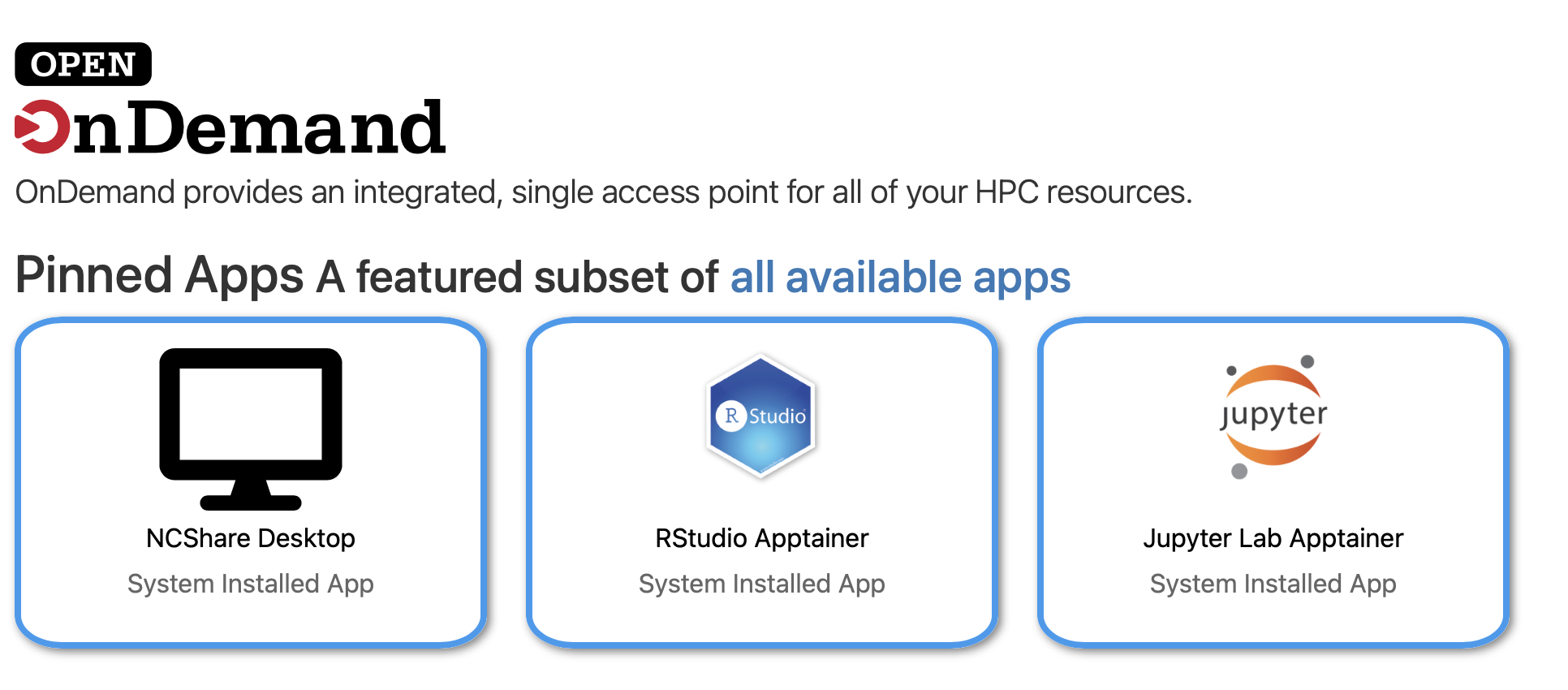
Once logged into Open OnDemand, you can select your desired container (e.g., Jupter Lab, RStudio etc.).
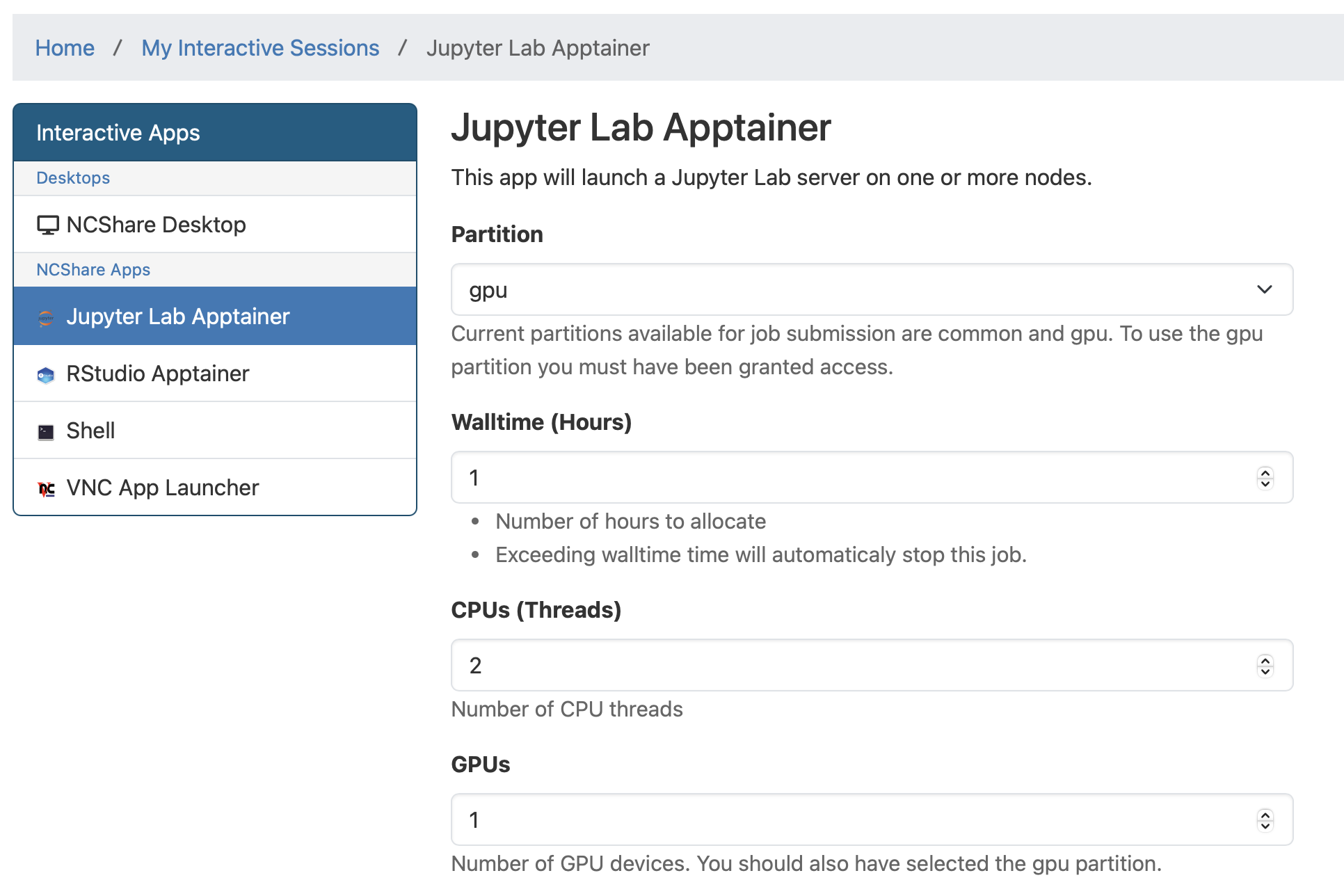
If you select Jupyter Lab, you will be taken to the Jupyter Lab Apptainer page where you should select gpu, interactive-gpu or gpu-hp under Partition and specify the number of GPUs you wish to use under GPUs. If using the gpu-hp partition, select QoS to be <institution-qos> from the drop down menu. Otherwise, leave it as normal. Then click Launch. A similar process can be followed for RStudio.
To verify if the notebook has connected to a GPU, you can run the following code that imports and runs a few PyTorch functions in a notebook cell:
import torch
print("torch:", torch.__version__)
print("torch.version.cuda:", torch.version.cuda)
print("torch.cuda.device_count():", torch.cuda.device_count())
print("torch.cuda.is_available():", torch.cuda.is_available())
If the cell execution shows an output similar to the following, Congratulations!, you have successfully connected to an H200 GPU!
torch: 2.8.0+cu128
torch.version.cuda: 12.8
torch.cuda.device_count(): 1
torch.cuda.is_available(): True
Using H200 GPUs with slurm
First, ensure that you are able to ssh into a NCShare login node from a terminal following the instructions given in the Register an ssh key guide.
Once, you have access to a login node, you will use the following slurm flags to request H200 GPUs for your job.
#SBATCH -p interactive-gpu
#SBATCH --gres=gpu:h200:1 #Upto 8
#SBATCH -p gpu-hp
#SBATCH --qos=<institution-qos>
#SBATCH --gres=gpu:h200:1 #Upto 8
where, <institution-qos> is the QoS value corresponding to your institutional account (see table in section gpu-hp partition).
Info
If you are using an Apptainer container to run your slurm job, you will need to include the --nv flag to mount the Nvidia CUDA libraries from the host environment into the container to enable GPU support.
Interactive GPU Session
To obtain an interactive GPU session, you can use a command like the following from a login node,
srun -p gpu --gres=gpu:h200:1 -t 1:00:00 --pty bash -i
# OR
srun -p interactive-gpu --gres=gpu:h200:1 -t 1:00:00 --pty bash -i
This requests 1 H200 GPU for 1 hour on the gpu or interactive-gpu partition. Similarly, to run an interactive session on the gpu-hp partition, you can use the following command,
To obtain information about your allocated GPU, you can run the nvidia-smi command once inside the interactive session.
(base) uherathmudiyanselage1 at compute-gpu-02 in /work/uherathmudiyanselage1
$ nvidia-smi
Mon Nov 3 07:48:27 2025
+-----------------------------------------------------------------------------------------+
| NVIDIA-SMI 570.172.08 Driver Version: 570.172.08 CUDA Version: 12.8 |
|-----------------------------------------+------------------------+----------------------+
| GPU Name Persistence-M | Bus-Id Disp.A | Volatile Uncorr. ECC |
| Fan Temp Perf Pwr:Usage/Cap | Memory-Usage | GPU-Util Compute M. |
| | | MIG M. |
|=========================================+========================+======================|
| 0 NVIDIA H200 On | 00000000:4B:00.0 Off | 0 |
| N/A 31C P0 74W / 700W | 0MiB / 143771MiB | 0% Default |
| | | Disabled |
+-----------------------------------------+------------------------+----------------------+
+-----------------------------------------------------------------------------------------+
| Processes: |
| GPU GI CI PID Type Process name GPU Memory |
| ID ID Usage |
|=========================================================================================|
| No running processes found |
+-----------------------------------------------------------------------------------------+
You can run your GPU tasks inside this interactive session. Once done, you can exit the session by typing exit or pressing Ctrl+D.
Slurm Batch Job Submission
For computationally intensive tasks, it is recommended to submit a batch job using a slurm job script. Below is an example slurm job script that requests 1 H200 GPU for 1 hour.
jobscript.sh:
#!/bin/bash
#SBATCH -J name_of_job
#SBATCH -p gpu #or gpu-hp for high-priority partition
#SBATCH --gres=gpu:h200:1
#SBATCH -t 1:00:00
##SBATCH --qos=<institution-qos> #Uncomment for gpu-hp partition
# Initialization
source ~/.bashrc
cd $SLURM_SUBMIT_DIR
cat << EOF > compute-gpu-01.py
#!/usr/bin/env python
import torch
print("torch:", torch.__version__)
print("torch.version.cuda:", torch.version.cuda)
print("torch.cuda.device_count():", torch.cuda.device_count())
print("torch.cuda.is_available():", torch.cuda.is_available())
EOF
chmod +x compute-gpu-01.py
./compute-gpu-01.py > compute-gpu-01.log
For advanced users who are running computationally intensive jobs, the following additional optional flags might be useful,
#SBATCH -N 1                 # Total no. of nodes
#SBATCH --ntasks-per-node 96 # Tasks per node
#SBATCH -c 2                 # CPUs per task
#SBATCH --mem=500G           # Memory per node
Remember that the higher the number of resources requested (e.g., number of nodes, GPUs etc.), the longer the job may wait in the queue before starting.
To submit the job script, use the following command from a login node:
You can monitor the status of your job using the squeue command:
Measuring efficiency
As the H200 GPUs are a limited shared resource, we encourage users to be mindful of their GPU usage and to use the resources efficiently. We will be sharing weekly usage reports with the goal of helping users better understand their GPU usage patterns and to support more efficient and effective use of the partition.
See Measuring Efficiency to learn about the tools available for measuring the CPU, memory, and GPU efficiency of your jobs, and for guidance on right-sizing your resource requests.