Running a Multi-Node MPI Job on NCShare
This guide introduces the key concepts of MPI for cross-node parallelization through an example that demonstrates the ring topology communication pattern. It is intended for users who are new to MPI and want to verify that their environment is configured correctly for running multi-node jobs on NCShare.
The code for this example is available at: https://github.com/NCShare/examples/tree/main/MPI-on-NCShare
This example introduces the Message Passing Interface (MPI) and walks through a short Fortran program, mpi_ring_test.f90, that exercises the two communication patterns found in nearly every parallel application: point-to-point messages between neighboring processes and a collective reduction across all of them.
The program is short, but it functions as a practical diagnostic. Running it across two NCShare compute nodes confirms that the compiler wrappers, the Slurm launcher, and the inter-node fabric are all working together before allocation time is committed to a production run.
What is MPI?
Laptops and individual compute nodes support parallelization with threads, where every worker shares a single pool of memory (shared-memory parallelism). That model is bounded by the node. To use more than one machine, each process requires its own private memory and an explicit mechanism for exchanging data. MPI is the standard that defines those exchanges, an approach known as distributed-memory parallelism.
The following terminology is used throughout this guide,
| Term | Meaning |
|---|---|
| Process / task | One independent copy of the program with its own memory. On NCShare, one Slurm task. |
| Rank | The integer ID of a process within a communicator, from 0 to nprocs-1. |
| Communicator | A group of processes that can communicate with each other. MPI_COMM_WORLD contains all of them. |
| Point-to-point | One rank sends, one rank receives (MPI_Send, MPI_Recv, MPI_Sendrecv). |
| Collective | All ranks in a communicator participate (MPI_Barrier, MPI_Bcast, MPI_Allreduce). |
MPI programs follow the SPMD model: single program, multiple data. Every rank executes the same executable. The ranks are distinguished only by the rank number returned by MPI_Comm_rank, and the code branches on that value to assign work.
Nearly every MPI program shares the same skeleton,
call MPI_Init(ierr)                              ! start the MPI environment
call MPI_Comm_rank(MPI_COMM_WORLD, rank, ierr)   ! rank of this process
call MPI_Comm_size(MPI_COMM_WORLD, nprocs, ierr) ! total number of processes

! ... computation and communication ...

call MPI_Finalize(ierr)                          ! shut down MPI
MPI and Slurm
Slurm and MPI have distinct responsibilities. Slurm handles resource allocation and process placement, determining how many tasks are started and on which nodes. MPI defines the communication layer between those processes. The two are coupled at launch time, when mpirun reads the Slurm allocation and starts one task per allocated slot on the assigned nodes.
MPI on NCShare
NCShare provides Open MPI system-wide. There is no environment module system on the cluster and nothing to load: the wrappers and the launcher are installed in /usr/bin and are on your PATH in every shell, interactive or batch.
This build was configured --with-slurm, so mpirun reads the Slurm allocation directly and places one task per allocated slot without any additional flags.
The compiler wrappers invoke the underlying compiler with the include paths, library paths, and link flags required by Open MPI,
| Language | Wrapper |
|---|---|
| Fortran | mpif90 / mpifort |
| C | mpicc |
| C++ | mpicxx |
To see which compiler a wrapper actually calls, along with the include and library paths it adds, use the --showme flag,
$ mpif90 --showme

gfortran -I/usr/lib/x86_64-linux-gnu/openmpi/lib/../../fortran/gfortran-mod-15/openmpi -I/usr/lib/x86_64-linux-gnu/openmpi/lib -L/usr/lib/x86_64-linux-gnu/openmpi/lib/fortran/gfortran -lmpi_usempif08 -lmpi_usempi_ignore_tkr -lmpi_mpifh -lmpi -lopen-rte -lopen-pal -lhwloc -levent_core -levent_pthreads -lm -lz
The wrapper calls the system gfortran, so no compiler needs to be loaded or installed either.
Do not let a Conda environment shadow the system MPI
Installing a package that pulls in its own MPI (mpi4py, openmpi, or mpich from conda-forge) places a second mpirun and a second set of wrappers ahead of /usr/bin on your PATH. Compiling with one MPI and launching with another produces confusing failures. Run which mpirun mpif90 to confirm both resolve to /usr/bin before you build, and either deactivate the environment or keep the whole toolchain inside it consistently.
Other MPI implementations
MPICH and Intel MPI are not provided on NCShare. Codes that require them can be installed into your home directory or /work with Conda or Spack, which does not require administrator privileges. An executable built against one MPI implementation will generally not run under another, so build and launch with the same one.
A minimal MPI program
Before introducing communication, confirm that ranks start correctly and are placed as requested. The program below reports the rank, communicator size, and hostname of each process. Save it as mpi_hello.f90,
program mpi_hello
  use mpi
  implicit none

  integer :: ierr, rank, nprocs, name_len
  character(len=MPI_MAX_PROCESSOR_NAME) :: hostname

  call MPI_Init(ierr)
  call MPI_Comm_rank(MPI_COMM_WORLD, rank, ierr)
  call MPI_Comm_size(MPI_COMM_WORLD, nprocs, ierr)
  call MPI_Get_processor_name(hostname, name_len, ierr)

  write (*,'(A,I0,A,I0,A,A)') 'Hello from rank ', rank, ' of ', nprocs, &
                              ' on ', trim(hostname)

  call MPI_Finalize(ierr)
end program mpi_hello
Request an interactive session with four tasks, then compile and run,
Hello from rank 1 of 4 on compute-08
Hello from rank 3 of 4 on compute-08
Hello from rank 2 of 4 on compute-08
Hello from rank 0 of 4 on compute-08
The interactive partition has a one hour wall-time limit, which is ample for a compile-and-check cycle. Use common for anything longer.
Four processes were started and each determined its own identity, but no data was exchanged between them. Communication is what the ring test adds.
The ring topology
The ring test arranges the ranks in a logical circle. Each rank has exactly one left neighbor and one right neighbor, and rank nprocs-1 wraps around to rank 0. Every rank simultaneously sends its own rank number to the right and receives its left neighbor's number.
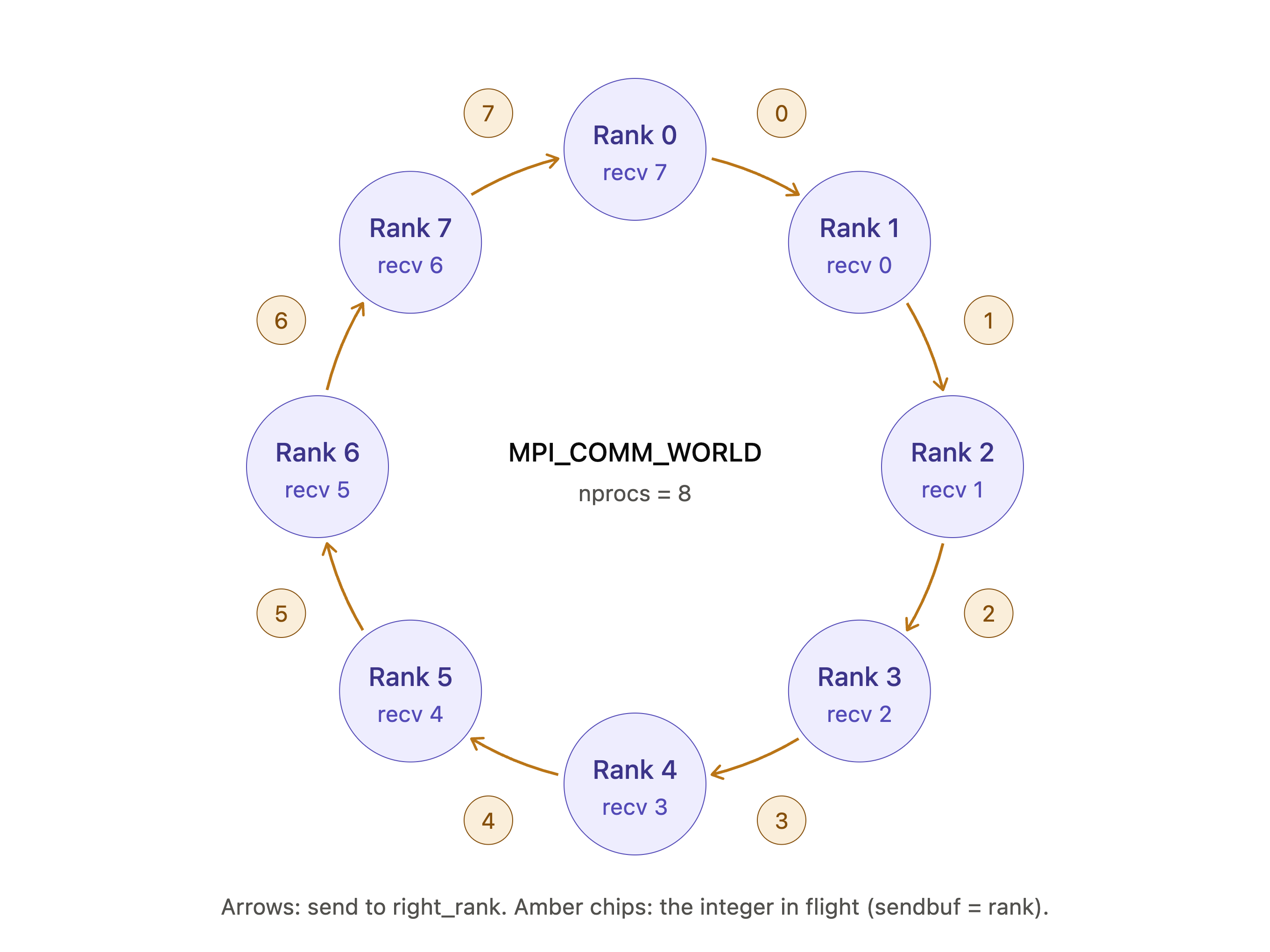
The neighbor indices follow from modular arithmetic,
The + nprocs term in the first expression is required. Fortran's mod takes the sign of its first argument, so mod(-1, 8) evaluates to -1 rather than 7. Adding nprocs before taking the modulus places the left neighbor of rank 0 at the top of the ring, as intended.
The code
The complete mpi_ring_test.f90 is shown below.
program mpi_ring_test
use mpi
implicit none
integer :: ierr
integer :: rank, nprocs, name_len
integer :: left_rank, right_rank
integer :: sendbuf, recvbuf, rank_sum
character(len=MPI_MAX_PROCESSOR_NAME) :: hostname
call MPI_Init(ierr)
call MPI_Comm_rank(MPI_COMM_WORLD, rank, ierr)
call MPI_Comm_size(MPI_COMM_WORLD, nprocs, ierr)
call MPI_Get_processor_name(hostname, name_len, ierr)
write (*,'(A,I0,A,I0,A,A)') 'Rank ', rank, ' of ', nprocs, ' on ', trim(hostname)
call MPI_Barrier(MPI_COMM_WORLD, ierr)
left_rank  = mod(rank - 1 + nprocs, nprocs)
right_rank = mod(rank + 1, nprocs)
sendbuf = rank
recvbuf = -1
! Exchange one integer with neighboring ranks to verify point-to-point traffic.
call MPI_Sendrecv(sendbuf, 1, MPI_INTEGER, right_rank, 0, &
                  recvbuf, 1, MPI_INTEGER, left_rank,  0, &
                  MPI_COMM_WORLD, MPI_STATUS_IGNORE, ierr)
write (*,'(A,I0,A,I0,A,I0)') 'Rank ', rank, ' received ', recvbuf, ' from rank ', left_rank
call MPI_Allreduce(rank, rank_sum, 1, MPI_INTEGER, MPI_SUM, MPI_COMM_WORLD, ierr)
if (rank == 0) then
write (*,'(A,I0)') 'Global rank sum = ', rank_sum
end if
call MPI_Finalize(ierr)
end program mpi_ring_test
Startup and identity
This imports the MPI module, which provides the named constants (MPI_COMM_WORLD, MPI_INTEGER, MPI_SUM, …) and the interfaces for the routines used below.
MPI_Init must be the first MPI call and MPI_Finalize the last. Between them, MPI_Comm_rank and MPI_Comm_size return the rank of the calling process and the total number of processes, while MPI_Get_processor_name returns the hostname, which confirms that the job spans two nodes.
The ierr argument
In the Fortran bindings, every MPI routine takes a trailing integer error code. By default MPI aborts the job on error, so production codes rarely inspect it, but omitting the argument is one of the most common compile-time errors for new users.
The barrier
MPI_Barrier blocks until every rank in the communicator has reached it. Here it separates the two phases of output so that the "Rank i of n" lines are not interleaved with the exchange results. It is a synchronization point, not a data transfer.
Barriers do not order output within a phase
A barrier orders phases, not individual lines. Standard output from multiple ranks is funneled through the launcher and can still arrive out of order within a phase, as the sample output below shows. Print ordering should not be used to infer execution order; use timers or rank-tagged output files instead.
The neighbor exchange
call MPI_Sendrecv(sendbuf, 1, MPI_INTEGER, right_rank, 0, &
recvbuf, 1, MPI_INTEGER, left_rank, 0, &
MPI_COMM_WORLD, MPI_STATUS_IGNORE, ierr)
The argument list has two halves,
| Arguments | Role |
|---|---|
sendbuf, 1, MPI_INTEGER, right_rank, 0 |
send 1 integer from sendbuf to right_rank with tag 0 |
recvbuf, 1, MPI_INTEGER, left_rank, 0 |
receive 1 integer into recvbuf from left_rank with tag 0 |
MPI_COMM_WORLD, MPI_STATUS_IGNORE, ierr |
communicator, discard the status object, error code |
The tag is a user-defined label that allows a receiver to distinguish messages that would otherwise match the same source and communicator. With a single message type in flight, 0 is sufficient.
MPI_Sendrecv is used here in preference to an MPI_Send followed by an MPI_Recv because a ring is precisely the topology in which the latter can deadlock. If every rank calls MPI_Send first and the message is too large for MPI to buffer internally, every rank blocks waiting for a matching receive that has not been posted. The program then hangs, and it does so only above a threshold message size, making the failure difficult to reproduce and diagnose. MPI_Sendrecv passes both halves of the exchange to MPI at once and allows the library to schedule them safely.
Alternatives
Non-blocking MPI_Isend / MPI_Irecv followed by MPI_Waitall are equally safe and allow communication to be overlapped with computation. MPI_Sendrecv is the simplest correct choice when there is no work available to overlap.
The collective reduction
MPI_Allreduce combines one value from every rank using a specified operation, here MPI_SUM, and delivers the result to all ranks. (MPI_Reduce delivers the result to a single root rank only.) Other operators include MPI_MAX, MPI_MIN, and MPI_PROD.
The result is self-verifying. Summing \(0 + 1 + \dots + (n-1)\) gives \(n(n-1)/2\), so with eight ranks the expected value is 28. Only rank 0 prints the result, a common idiom that keeps the output readable.
Compiling
mpif90 invokes the underlying Fortran compiler with the MPI headers and libraries already supplied on the command line.
The job script
jobscript.sh is a Slurm batch job script that requests two nodes with four tasks each, for eight MPI ranks in total,
#!/bin/bash
#SBATCH -J mpi_ring_test      # Job name
#SBATCH -p common             # Partition name
#SBATCH -N 2                  # Total # of nodes
#SBATCH --ntasks-per-node 4   # Tasks per node

cd $SLURM_SUBMIT_DIR

# Compile
mpif90 mpi_ring_test.f90 -o mpi_ring_test

# Execute
mpirun -n $SLURM_NTASKS ./mpi_ring_test > mpi_ring_test_output.txt
Submit the job and monitor it with,
Compile once rather than on every run
Compiling inside the job script keeps a small example such as this one self-contained, but it consumes allocated node time on a step that does not require a parallel allocation. For larger production applications, compile on the login node and have the job script launch the executable only.
Output
The program produces the following output.
Rank 0 of 8 on compute-06
Rank 1 of 8 on compute-06
Rank 2 of 8 on compute-06
Rank 3 of 8 on compute-06
Rank 4 of 8 on compute-07
Rank 5 of 8 on compute-07
Rank 6 of 8 on compute-07
Rank 7 of 8 on compute-07
Rank 0 received 7 from rank 7
Rank 3 received 2 from rank 2
Rank 4 received 3 from rank 3
Rank 7 received 6 from rank 6
Rank 1 received 0 from rank 0
Rank 2 received 1 from rank 1
Rank 6 received 5 from rank 5
Rank 5 received 4 from rank 4
Global rank sum = 28
Three points are worth noting.
-
The job spanned two nodes
Ranks 0–3 were placed oncompute-06and ranks 4–7 oncompute-07, as requested by-N 2 --ntasks-per-node 4. Slurm assigns ranks in blocks by node, so the3 → 4and7 → 0links of the ring cross the network while the remaining links stay within a node. -
Every exchange completed correctly
Each line reportsRank r received r-1 from rank r-1, and the wrap-around line,Rank 0 received 7 from rank 7, closes the circle. A rank reporting-1would indicate that its receive never completed. -
The reduction is consistent
\(28 = 8 \times 7 / 2\), confirming that all eight ranks contributed to the collective.
The exchange lines are not sorted, which is expected. The eight ranks write to standard output concurrently and the launcher merges those streams in the order they arrive. That the identity lines happen to appear in rank order in this particular run is incidental and should not be relied upon. The barrier is nevertheless effective: all eight identity lines appear before any exchange line.
Checklist: what a successful run confirms
- The compiler wrappers resolved to the system Open MPI and worked.
- Slurm placed the requested number of ranks on the requested number of nodes.
- Point-to-point messages crossed both intra-node and inter-node boundaries.
- Collective communication completed across the full communicator.
- The job ran to completion and called
MPI_Finalizecleanly.
If the ring test passes but a production code still fails, the fault lies in the application or its input rather than in the MPI environment, which considerably narrows the search.
Troubleshooting
Error: Can't open module file 'mpi.mod'
The source was compiled with gfortran instead of mpif90. Compile with the wrapper, which supplies the MPI include and library paths.
error while loading shared libraries: libmpi...
The executable was built against an MPI that is not on the library path at run time, which on NCShare almost always means a Conda environment was active during the build but not in the job. Run which mpif90 and which mpirun in both places and make them agree.
All ranks report Rank 0 of 1
The launcher did not see the Slurm allocation and started a single independent process instead. Verify that -n $SLURM_NTASKS is passed to mpirun, and that mpirun is the system one in /usr/bin rather than a Conda copy that was built without Slurm support.
The job hangs with no output
This is the signature of a send/receive deadlock, which is the reason this example uses MPI_Sendrecv rather than a separate MPI_Send and MPI_Recv.
All ranks are placed on one node
Confirm that -N 2 is present in the job script and is not overridden by a later --nodes directive.